
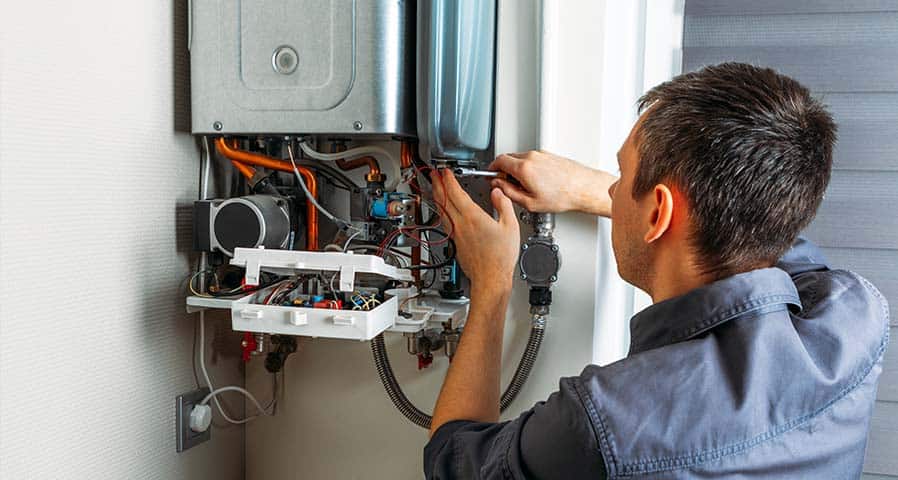
Commercial winter preparation should include a boiler tune-up, safety-control testing, distribution-system checks, and a documented steam-trap audit. Identifying problems early gives facility teams time to complete repairs before heating demand peaks. Qualifying utility rebates can also offset selected equipment upgrades and steam trap repairs.
Key Takeaways
- Schedule commercial boiler service early enough to complete corrective work before sustained cold weather.
- Test safety controls and combustion performance instead of relying on successful startup.
- Inspect steam traps, condensate returns, and pipe insulation as part of the complete heating system.
- Keep inspection findings and repair records to support maintenance planning and rebate applications.
- Confirm utility eligibility before purchasing equipment or authorizing incentive-dependent work.
What should a commercial boiler maintenance checklist include before the first freeze?
A commercial boiler maintenance checklist should cover safety devices, heating controls, and heat-distribution equipment.
Successful ignition does not verify safe operation. Technicians must compare operating pressure with the equipment specifications and system design.
For commercial buildings with furnaces or air handlers, check filters, supply/return airflow, and control settings. Boiler-only systems require water or steam distribution checks instead.
| Maintenance area | What to check for commercial operation |
| Safety controls | Have a qualified technician test low-water cutoffs, operating limits, flame safeguards, and applicable safety devices under manufacturer procedures. |
| Combustion and venting | Inspect burners, fuel-system integrity, and combustion-air/exhaust paths; measure stack temperature, excess air, flue-gas O₂/CO₂ concentrations, and carbon monoxide (CO) in ppm. |
| Water and heat-transfer surfaces | Inspect for scale, corrosion, sludge, and leaks; review water treatment and steam-boiler blowdown practices. |
| Distribution equipment | Check circulating or condensate pumps, return lines, valves, and damaged or missing insulation, as applicable. |
| Building controls | Verify heating schedules, temperature sensors, alarms, and outdoor reset settings where installed. |
Plan boiler tuning at least once per operating year, with routine water-chemistry checks and condensate pump maintenance.
What does a commercial boiler tune-up include before winter?
A commercial boiler tune-up includes cleaning and equipment-specific adjustments, measured combustion testing, and verification of operating controls.
Ask the contractor to document findings, adjustments, unresolved defects, and recommended repairs.
Stack temperature indicates heat leaving through the exhaust. Flue-gas oxygen (O₂) and carbon dioxide (CO₂) concentrations help evaluate the fuel-to-air balance and excess air. Carbon monoxide (CO), measured in parts per million (ppm), helps identify incomplete combustion. Compare readings with manufacturer limits for the fuel and firing rate.
Facility staff can monitor alarms, leaks, and unusual noises, while qualified personnel adjust fuel, work on the pressure system, and test safety devices.
How can facility managers identify leaking or failed steam traps?
Facility managers can flag uneven heating, abnormal condensate behavior, or new banging noises, then arrange a steam trap inspection to confirm the cause.
Steam traps drain condensate (condensed steam) while retaining useful steam. Failed-open traps waste steam. Failed-closed or plugged traps impede drainage, allowing condensate to collect and increasing the risk of water hammer and localized heating loss. Corrosive condensate can accelerate pipe deterioration.
Sudden temperature changes during restart can cause thermal shock. Trapped water in exposed equipment can freeze and rupture piping or trap bodies.
Technicians use ultrasonic testing to evaluate flow sounds, infrared thermography or infrared pyrometers to assess temperatures, and visual inspection through installed test valves where safe and appropriate. Temperature alone cannot reliably establish trap condition. Record each trap’s location, identification number, failure status, and corrective action.
How does a steam trap audit help reduce commercial heating costs? It locates steam losses and prioritizes repairs. Systems neglected for three to five years may have failed traps representing 15%–30% of the population; actual rates vary.
Which utility rebates help cover commercial boiler upgrades and steam trap replacement?
Commercial boiler and steam trap rebates depend on the serving utility, equipment specifications, and documented project scope.
| Utility and region | Relevant rebate examples | Key eligibility distinction |
| PGW EnergySense, Philadelphia, Pennsylvania | Commercial boilers: $2,700–$9,000 by capacity at ≥92% thermal efficiency; outdoor reset controls: $400; steam traps: $50–$150 by pressure category. | Qualifying PGW firm-rate premises; steam trap incentives apply to retrofit projects. |
| UGI, eligible Pennsylvania gas customers | ENERGY STAR certified commercial boilers: $2,000 plus $2 per MBH. | Covers qualifying purchases and installations, rather than routine tune-ups. |
| Consumers Energy, eligible Michigan customers | Incentives for qualifying failed-open steam trap repairs or replacements. | Requires a maintenance survey and documented repair results; failed-closed or plugged traps do not qualify under these measures. |
PGW also lists qualifying commercial storage and tankless water heaters at $4.25 per MBH with ≥96% thermal efficiency.
UGI requires applications within 90 days of installation and qualifying installation before September 30, 2027, subject to funding. PGW lists availability through August 31, 2027, subject to funds.
For Consumers Energy, confirm the current incentive amount and application requirements before repairs. A survey alone does not establish payment eligibility.
Frequently Asked Questions
Do all commercial boilers have steam traps?
No. Steam traps serve steam systems. Hot-water boilers distribute heated water and require different maintenance checks.
Can a seasonal tune-up replace a required boiler inspection?
Do not assume it can. Confirm applicable inspection requirements with the jurisdiction, insurer, and qualified boiler contractor.
What does MBH mean in a boiler rebate?
MBH means 1,000 Btu per hour. A rating of 300,000 Btu per hour equals 300 MBH.
Schedule Maintenance and Check Incentives Before Work Begins
Book the inspection, assign corrective work, and review rebate eligibility before equipment orders. Contact Incentive Rebate360 to evaluate qualifying improvements and coordinate application documentation while your maintenance contractor prepares the system for winter.
Click here to read the full article, originally published by Six Star Heating and Cooling.
Customer Reviews
No reviews yet. Be the first to leave a reply.